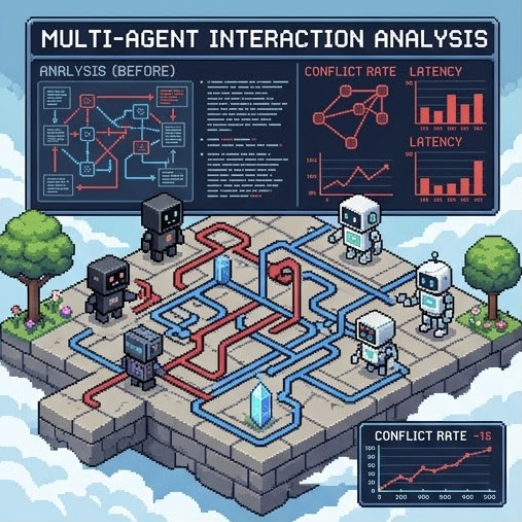
Multi-Agent AI Systems
Analyzing and optimizing interactions in multi-agent AI systems.
I am a Ph.D. student at the School of Computer Science, The University of Auckland.
Previously, I received my M.S. degree in Computer Technology from the University of Electronic Science and Technology of China (UESTC) in 2025 and my B.S. degree from UESTC in 2022.

My research lies at the intersection of Artificial Intelligence and Economic Theory, with a focus on understanding and optimizing interactions among intelligent agents and designing effective mechanisms for emerging AI ecosystems.
Specifically, my research topics center on Multi-Agent AI Systems and AI Marketplace Design, especially in:
Analyzing and optimizing interactions in multi-agent AI systems.
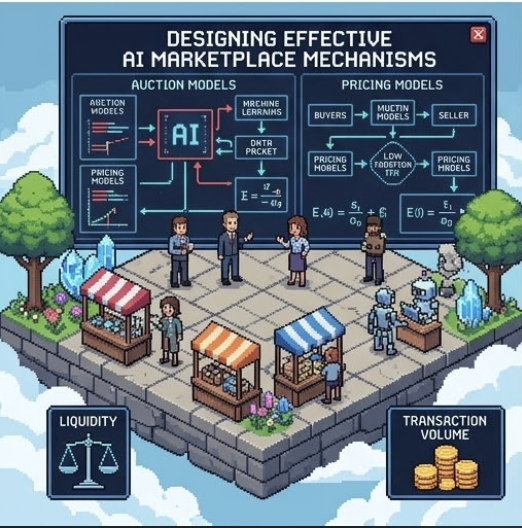
Designing effective mechanisms for the AI marketplace.
| 2026-09 | ✳A2A Auction Protocol: An auction business protocol for AI agents communicating over A2A. |
|---|---|
| 2026-08 | ✳One paper multi-agent Webpage Generation is accepted by EMNLP 2026. |
| 2026-04 | ✦My Chrome extension QuickPage Capture is now available on the Chrome Web Store. |
Runchen Xu, Mengxiao Zhang, Yikai Gu, Jiamou Liu
EMNLP 2026 Findings
A style-aware webpage generation framework that uses multi-agent collaboration and style contracts to control and preserve visual design intent.
Runchen Xu, Mengxiao Zhang, Jiamou Liu
ECML PKDD 2026
A mechanism-design approach for sustainable federated session-based recommender systems.
Runchen Xu, Lu Yu, Zheng Chang
IEEE 36th International Symposium on Personal, Indoor and Mobile Radio Communications (PIMRC), 2025
A contract-theoretic incentive mechanism for AI-generated content services in vehicle edge computing.
Runchen Xu, Zheng Chang, Zhu Han, Sahil Garg, Georges Kaddoum, Joel J. P. C. Rodrigues
IEEE Internet of Things Journal, 2024
Joint optimization of sensing and computation in MEC-assisted IoT systems using mean-field game theory.
Runchen Xu, Zheng Chang, Xinran Zhang, Timo H"am"al"ainen
IEEE Internet of Things Journal, 2024
A blockchain-enabled resource trading framework for multi-UAV edge computing systems.
Runchen Xu, Zheng Chang, Zhiwei Zhao, Geyong Min
IEEE Global Communications Conference, 2023
A contract-based incentive framework for blockchain-enabled federated learning in vehicle edge computing.
Courses I have assisted with at the University of Auckland.
The University of Auckland, New Zealand.
The University of Auckland, New Zealand.
The University of Auckland, New Zealand. May 2026 - Jun. 2026.
The University of Auckland, New Zealand. Nov. 2025 - Feb. 2026.